

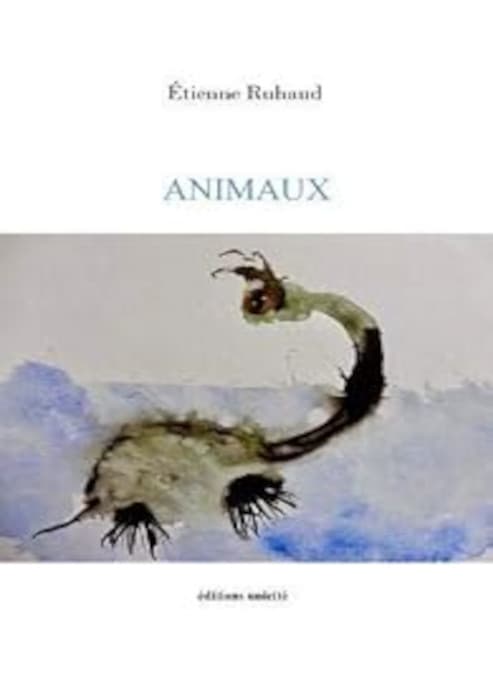
A fantastic bestiary in which zoological invention meets poetry, and where monsters sometimes bear a disturbing resemblance to human beings.
Since antiquity, fabulous animals have haunted the human imagination. From Greek mythological creatures to medieval bestiaries, from travellers’ accounts to Borges’s inventions, they inhabit a literature in which the observation of living things readily mingles with wonder. Étienne Ruhaud belongs to this tradition with Animaux, a collection of thirty short pieces at the crossroads of poetic prose, fantasy and imaginary natural history.
The author invents a singular fauna, sometimes gigantic and often unsettling, describing its anatomy, habits and relationships with humanity in minute detail. Yet beneath the apparent simplicity of these zoological entries lies a more complex work, permeated by violence, deformity, beauty, cruelty and death.
The reign of excess
One of the most striking features of this bestiary is the omnipresence of gigantism. Across the texts, the same indications of extraordinary size recur: “giants”, “gigantic”, “invasive”, “as big as ponies”, “three metres tall”, “four metres long”, “vast jellyfish”, “very tall”, “vast bats”…
This insistence is no accident. Size becomes a means of estrangement. A familiar animal, suddenly enlarged beyond measure, enters the realm of the fantastic. There is no longer any need to invent an entirely new anatomy: sometimes changing its proportions is enough to make it monstrous. Slugs reach four metres, scorpions measure several metres in length, and vampires have an enormous wingspan. The rostres, meanwhile, resemble immense basalt formations before revealing their organic nature.
This preference for excess creates an oppressive impression. Humanity is no longer at the centre of the living world. Human beings become prey among other prey, a fragile presence in a world seemingly beyond their control. The repetition of these descriptive openings may also be one of the collection’s stylistic limitations. Frequent adjectives of magnitude and comparisons of dimensions may eventually make some entries predictable. The wonder sought through hyperbole could thereby lose its edge.
Yet this recurrence also contributes to the unity of the book: it establishes a genuine scale of monstrosity, as though the reader were travelling through a world whose proportions had been systematically overturned.
Prose shaped by verse
It would be reductive to regard these texts as mere exercises in zoological imagination. Their writing reveals a keen sensitivity to the sounds of language. Certain sentences seem built around balanced rhythmic groups, parallel constructions or cadences recalling traditional versification. Thus, in “grandes comme la main, dures comme le roc” (“as large as a hand, hard as rock”), the repetition of “comme” creates an immediately perceptible symmetry and balances the two hemistichs of a French alexandrine. The two parts answer each other, while the hard consonants give the statement a mineral density through the twelve-syllable cadence at the end of the sentence.
Other formulations, such as “accrochés dans les grottes, au milieu de la jungle” (“hanging in caves, in the middle of the jungle”) or “enfoncés dans les tombes, au milieu des marais” (“buried in tombs, amid the marshes”), reveal a binary structure that at times approaches the breathing of the alexandrine or the six-syllable line. These are not necessarily regular alexandrines, hexasyllables or decasyllables. The pronunciation of mute e’s, in particular, may change the syllable count. Yet the ear detects segments tending towards regular verse, balanced phrases and pauses suggestive of the caesura.
“As large as a hand, hard as rock”
This closeness to verse is interesting precisely because it remains discreet. Étienne Ruhaud does not attempt to write regular poems disguised as prose. Rather, an intermittent musicality seems to rise to the surface of his sentences. Syntactic repetitions play an essential role here. Anaphora, parallelism and enumeration give certain passages an almost incantatory cadence. The sentence moves forward in successive groups, sometimes swift and abrupt, sometimes more expansive.
Alliteration and assonance contribute to this effect. In “grandes comme la main, dures comme le roc”, plosive consonants lend firmness to the description. In “enfoncés dans les tombes, au milieu des marais”, nasal sounds and dark vowels accompany the evocation of a funereal landscape. Elsewhere, the interplay of sounds helps create an atmosphere.
In Les Ouranis, the phrase “Mer perdue, flaque d’infinie tristesse” (“Lost sea, puddle of infinite sadness”) links the immensity of the sea to an image of stagnation and desolation. Liquid and fricative sounds soften the delivery, while the paradoxical juxtaposition of sea and puddle produces an almost motionless melancholy. In Les Lunes, the “fausses planètes de charbon” (“false planets of coal”) condense a cosmic and funereal vision into a few words. The image has the force of a solitary line of poetry.
Rhythm also depends on the brevity of certain sentences. “Et pourtant ça bouge” (“And yet it moves”), in Les Rostres, introduces a sudden break after a mineral description. A handful of words suffices to turn the landscape towards unease.
This alternation between descriptive passages and short sentences is one of the most effective devices in the writing.
Horror and beauty
“Lost sea, puddle of infinite sadness”
Étienne Ruhaud’s world is profoundly organic. Flesh occupies a central place: membranes, entrails, venoms, secretions, wounds and processes of decomposition abound. The body is never a reassuring shell. It may deform, tear, dissolve or abruptly reveal what it conceals.
Le Tératon offers a particularly moving variation on this aesthetic of deformity. The animal resembles a wretched cat, but its translucent abdomen exposes its organs. Yet the creature purrs and seeks the narrator’s affection. Rejected, it sadly walks away. This brief piece goes beyond horrific description to question our relationship with appearances. Physical monstrosity does not coincide with moral monstrosity. The most repulsive being may also be the most vulnerable.
Conversely, the ouranis seduce through their floral beauty before dragging their victims to an atrocious death. The flower becomes a trap; the embrace, a dissolution.
This constant reversal of appearances is one of the collection’s most interesting aspects. Beauty can kill; ugliness can love. In Étienne Ruhaud’s work, nature obeys no human morality. It creates splendid or hideous forms without regard for our aesthetic categories.
A political and social zoology
Behind the fantastic descriptions lies a reflection on human societies.
In Les Scorpions, the gigantic creatures are not merely formidable predators: the state uses them to eliminate opponents, outcasts and offenders. Natural horror thus becomes an instrument of political horror. The monster is no longer only the animal, but the power that turns its ferocity into a method of government.
In Les Manes, a community of hominids survives through a form of coexistence with giant tarantulas. In exchange for protection, it surrenders the sick, elderly and disabled to them. This social organisation, described with almost ethnographic neutrality, raises a profoundly human question: how far may a community go to ensure its own survival?
Les Muskels explore other forms of violence. Their hallucinogenic secretions are used in initiation rituals that can prove fatal. The animals, worshipped as gods by some populations, also become victims of tourism and poaching.
Thus imaginary creatures do not merely provoke fear or amazement. They reveal the contradictions of the societies around them: superstition and rationality, protection and exploitation, necessity and cruelty.
The author does not develop these issues as a moral discourse. He allows them to emerge from the situations themselves, maintaining a distance that strengthens their impact.
Between imaginary encyclopaedia and dark poetry
The short form adopted by Étienne Ruhaud strongly contributes to the book’s identity.
Each text constitutes a kind of self-contained entry. The author introduces a species, describes its characteristics, then sets out its behaviour and relations with human beings. This organisation recalls popular works of natural history, but also ancient bestiaries in which real animals appeared alongside fabulous creatures.
In some respects, one may also think of Jorge Luis Borges’s Book of Imaginary Beings, although Étienne Ruhaud places greater emphasis on the materiality of bodies and physiological details.
This repetitive structure has advantages. It lends coherence to the collection and allows the reader to enter each new invention immediately. But it can also produce a certain monotony when the texts remain primarily descriptive—a monotony that ultimately resembles an incantatory litany.
The most striking successes seem to occur when an entry opens onto another dimension: an unexpected emotion, a poetic image, a moral question or a political perspective. That is why Le Tératon, Les Lunes, Les Ouranis and Les Scorpions seem to me particularly representative of what this writing can achieve. In these pieces, the animal ceases to be a mere curiosity and becomes the vehicle for a vision.
Étienne Ruhaud’s originality also lies in the contrast between the rawness of his imagination and the restraint of his expression. He willingly describes the most improbable atrocities with a naturalist’s detachment. This apparent neutrality sometimes makes the scenes more disturbing than overt dramatisation would.
“False planets of coal”
And when a verse-like cadence, insistent alliteration or especially evocative image emerges, the prose seems momentarily to break free of its descriptive function. It is then that the bestiary becomes poetry in the fullest sense.
The distorting mirror of our humanity
With Animaux, Étienne Ruhaud offers far more than a gallery of monsters. He builds a universe in which the boundaries between human and animal, beautiful and repulsive, nature and civilisation remain uncertain. The book does not constantly seek grace. On the contrary, it cultivates discomfort, excess, deformity and violence. Its imaginary world can disturb, even repel. Yet this aesthetic of unease has its own coherence.
The rhythmic craftsmanship deserves particular attention in this respect. Binary cadences, consonantal echoes, syntactic repetitions and fragments of verse surfacing beneath the prose all testify to a desire to move beyond mere description.
One might regret certain repetitions, especially openings built around excess, or wish that some entries developed their narrative and symbolic potential further. These reservations, however, do not erase the singularity of the whole; above all, as noted, the repetitions act as incantatory litanies, bringing forth new monsters, new animals.
This imaginary world bears a strange resemblance to our own. Here, beings kill, hunt, exploit and sacrifice the weak. They seek pleasure, protection, power and survival. Monstrosity never belongs exclusively to animals. At the end of this exploration, one impression remains: Étienne Ruhaud’s Animaux may be less anomalies of nature than intensified manifestations of its laws, its violence and its contradictions.
A bestiary in which the fantastic interrogates reality, prose allows verse to be heard, and monsters ultimately hold up a mirror to us.